
1
Introduction
2 min•269 words
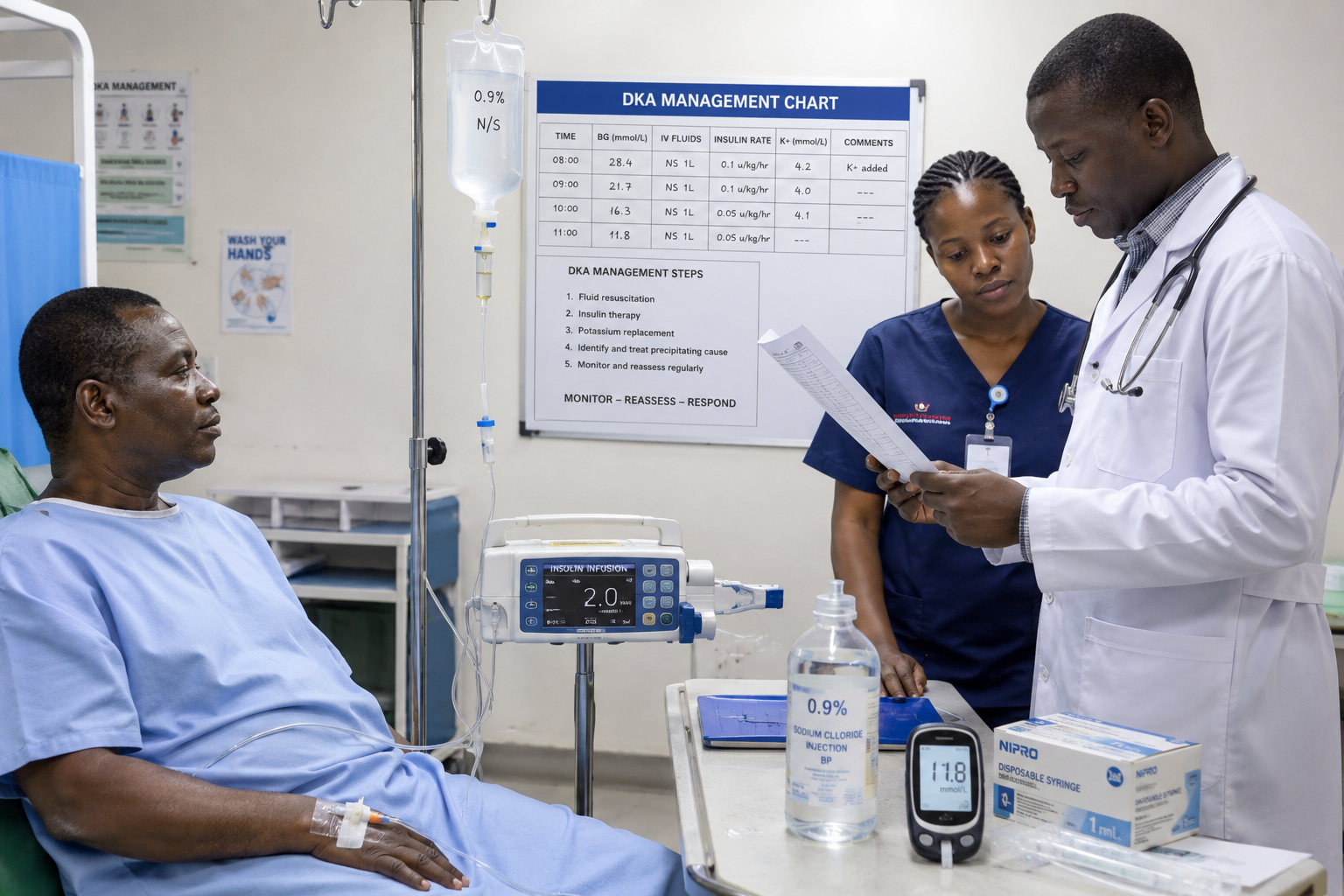
Diabetic ketoacidosis, commonly abbreviated as DKA, is an acute and life-threatening complication of diabetes mellitus. It occurs when there is insufficient effective insulin action, leading to hyperglycaemia, ketone production, metabolic acidosis, dehydration, and electrolyte disturbance. DKA is a medical emergency because deterioration can occur quickly, especially when diagnosis is delayed, fluids are inadequate, insulin is interrupted, potassium is not monitored, or hypoglycaemia is not prevented during treatment.
This course focuses on the management of adult, non-pregnant patients with DKA. It is based on the Kiruddu National Referral Hospital adult DKA guideline and bedside nursing summary. Separate approaches are required for children and for pregnant patients, because both groups have different physiological risks and require more specialised protocols. [1] [2]
The aim of DKA management is not simply to reduce blood glucose. The main goal is to stop ketogenesis, correct acidosis, restore circulating volume, replace potassium safely, identify and treat the precipitating cause, and transition the patient safely back to subcutaneous insulin once DKA has resolved.
By the end of this course, the learner should be able to:
1. Recognise DKA clinically and biochemically.
2. Apply the adult DKA diagnostic criteria.
3. Initiate safe first-hour resuscitation.
4. Prepare and calculate a fixed-rate intravenous insulin infusion.
5. Replace fluids and potassium according to the patient’s clinical status and laboratory results.
6. Monitor response using the bicarbonate trend where blood beta-hydroxybutyrate testing is not available.
7. Prevent hypoglycaemia while continuing insulin to clear ketones.
8. Identify severe DKA and escalate early.
9. Transition safely from intravenous insulin to subcutaneous insulin.
10. Refer all DKA patients for specialist diabetes review within 24 hours.
This course focuses on the management of adult, non-pregnant patients with DKA. It is based on the Kiruddu National Referral Hospital adult DKA guideline and bedside nursing summary. Separate approaches are required for children and for pregnant patients, because both groups have different physiological risks and require more specialised protocols. [1] [2]
The aim of DKA management is not simply to reduce blood glucose. The main goal is to stop ketogenesis, correct acidosis, restore circulating volume, replace potassium safely, identify and treat the precipitating cause, and transition the patient safely back to subcutaneous insulin once DKA has resolved.
By the end of this course, the learner should be able to:
1. Recognise DKA clinically and biochemically.
2. Apply the adult DKA diagnostic criteria.
3. Initiate safe first-hour resuscitation.
4. Prepare and calculate a fixed-rate intravenous insulin infusion.
5. Replace fluids and potassium according to the patient’s clinical status and laboratory results.
6. Monitor response using the bicarbonate trend where blood beta-hydroxybutyrate testing is not available.
7. Prevent hypoglycaemia while continuing insulin to clear ketones.
8. Identify severe DKA and escalate early.
9. Transition safely from intravenous insulin to subcutaneous insulin.
10. Refer all DKA patients for specialist diabetes review within 24 hours.
2
Background & Pathophysiology
3 min•473 words
DKA develops when there is an absolute or relative deficiency of insulin together with increased counter-regulatory hormones such as glucagon, cortisol, adrenaline, and growth hormone. This combination causes increased hepatic glucose production, reduced peripheral glucose uptake, increased lipolysis, and increased production of ketoacids.
The major biochemical problems in DKA are:
1. Hyperglycaemia.
2. Ketonaemia or ketonuria.
3. Metabolic acidosis.
4. Dehydration.
5. Electrolyte disturbance, especially potassium depletion.
Insulin deficiency prevents glucose from entering insulin-dependent tissues efficiently. The body responds as though it is in a starvation state, despite the presence of high blood glucose. Lipolysis increases, free fatty acids are delivered to the liver, and these are converted into ketone bodies. The major ketone bodies are beta-hydroxybutyrate, acetoacetate, and acetone.
In early DKA, beta-hydroxybutyrate is the predominant ketoacid. However, urine ketone dipsticks mainly detect acetoacetate and detect acetone less strongly. They do not detect beta-hydroxybutyrate. This means urine dipsticks may underestimate ketosis at presentation. During recovery, beta-hydroxybutyrate is converted back into acetoacetate, so urine ketones may remain positive even when the patient is improving. For this reason, where blood ketone meters are not available, the bicarbonate trend on venous blood gas is a more reliable marker of response to treatment than urine ketones alone.
Hyperglycaemia causes osmotic diuresis. The patient loses water, sodium, potassium, phosphate, and other electrolytes through urine. This leads to dehydration, hypovolaemia, tachycardia, hypotension, reduced renal perfusion, and worsening hyperglycaemia.
Potassium management is one of the most important safety issues in DKA. Many patients with DKA have total body potassium depletion because of osmotic diuresis, vomiting, and poor intake. However, serum potassium may be normal or high at presentation because acidosis and insulin deficiency shift potassium out of cells. Once insulin is started and acidosis begins to correct, potassium shifts back into cells and serum potassium can fall rapidly. Severe hypokalaemia can cause arrhythmias, muscle weakness, respiratory failure, and death. Therefore, potassium must be monitored and replaced carefully.
DKA is classically associated with type 1 diabetes, but it can also occur in type 2 diabetes during major physiological stress such as severe infection, myocardial infarction, pancreatitis, missed treatment, or other serious illness. In local practice, important precipitants include new diagnosis of type 1 diabetes, insulin omission due to cost or stock-out, poor sick-day management, infections, tuberculosis, malaria, myocardial infarction, steroid use, alcohol, and pancreatitis.
Euglycaemic DKA is an important special situation. It may occur when the blood glucose is below the usual DKA threshold, especially in patients using SGLT2 inhibitors such as dapagliflozin or empagliflozin. If an unwell patient is on an SGLT2 inhibitor, DKA should still be considered even if glucose is not very high. Urine ketones and venous blood gas should be checked, the SGLT2 inhibitor should be held, and if DKA criteria are met, treatment should follow the DKA protocol with 10% dextrose started from the outset.
The major biochemical problems in DKA are:
1. Hyperglycaemia.
2. Ketonaemia or ketonuria.
3. Metabolic acidosis.
4. Dehydration.
5. Electrolyte disturbance, especially potassium depletion.
Insulin deficiency prevents glucose from entering insulin-dependent tissues efficiently. The body responds as though it is in a starvation state, despite the presence of high blood glucose. Lipolysis increases, free fatty acids are delivered to the liver, and these are converted into ketone bodies. The major ketone bodies are beta-hydroxybutyrate, acetoacetate, and acetone.
In early DKA, beta-hydroxybutyrate is the predominant ketoacid. However, urine ketone dipsticks mainly detect acetoacetate and detect acetone less strongly. They do not detect beta-hydroxybutyrate. This means urine dipsticks may underestimate ketosis at presentation. During recovery, beta-hydroxybutyrate is converted back into acetoacetate, so urine ketones may remain positive even when the patient is improving. For this reason, where blood ketone meters are not available, the bicarbonate trend on venous blood gas is a more reliable marker of response to treatment than urine ketones alone.
Hyperglycaemia causes osmotic diuresis. The patient loses water, sodium, potassium, phosphate, and other electrolytes through urine. This leads to dehydration, hypovolaemia, tachycardia, hypotension, reduced renal perfusion, and worsening hyperglycaemia.
Potassium management is one of the most important safety issues in DKA. Many patients with DKA have total body potassium depletion because of osmotic diuresis, vomiting, and poor intake. However, serum potassium may be normal or high at presentation because acidosis and insulin deficiency shift potassium out of cells. Once insulin is started and acidosis begins to correct, potassium shifts back into cells and serum potassium can fall rapidly. Severe hypokalaemia can cause arrhythmias, muscle weakness, respiratory failure, and death. Therefore, potassium must be monitored and replaced carefully.
DKA is classically associated with type 1 diabetes, but it can also occur in type 2 diabetes during major physiological stress such as severe infection, myocardial infarction, pancreatitis, missed treatment, or other serious illness. In local practice, important precipitants include new diagnosis of type 1 diabetes, insulin omission due to cost or stock-out, poor sick-day management, infections, tuberculosis, malaria, myocardial infarction, steroid use, alcohol, and pancreatitis.
Euglycaemic DKA is an important special situation. It may occur when the blood glucose is below the usual DKA threshold, especially in patients using SGLT2 inhibitors such as dapagliflozin or empagliflozin. If an unwell patient is on an SGLT2 inhibitor, DKA should still be considered even if glucose is not very high. Urine ketones and venous blood gas should be checked, the SGLT2 inhibitor should be held, and if DKA criteria are met, treatment should follow the DKA protocol with 10% dextrose started from the outset.
3
Clinical Features
2 min•269 words
DKA may present gradually over hours to days, but once severe dehydration and acidosis develop, the patient can deteriorate rapidly.
Common symptoms include:
1. Polyuria.
2. Polydipsia.
3. Weight loss.
4. General body weakness.
5. Nausea and vomiting.
6. Abdominal pain.
7. Reduced appetite.
8. Shortness of breath or deep breathing.
9. Fever or symptoms of infection.
10. Confusion, drowsiness, or coma in severe cases.
Common examination findings include:
1. Dehydration.
2. Dry mucous membranes.
3. Tachycardia.
4. Hypotension or postural hypotension.
5. Poor peripheral perfusion.
6. Deep acidotic breathing, often called Kussmaul breathing.
7. Acetone or fruity smell on breath.
8. Abdominal tenderness.
9. Altered mental state.
10. Signs of precipitating illness such as pneumonia, urinary tract infection, cellulitis, malaria, tuberculosis, myocardial infarction, or pancreatitis.
Severe DKA should be suspected when any one of the following is present:
1. Urine ketones 3+ or more.
2. Serum bicarbonate less than 5 mmol/L.
3. Venous pH less than 7.1.
4. Serum potassium less than 3.5 mmol/L on admission.
5. Glasgow Coma Scale less than 12.
6. Systolic blood pressure less than 90 mmHg.
7. Pulse rate more than 100 beats per minute or less than 60 beats per minute.
Severe DKA requires early senior review, admission to a high-dependency or intensive care setting where possible, and consultant input within one hour.
The clinician must not stop at confirming DKA. Every patient should be assessed for the precipitating cause. Missing the precipitant is a major reason for poor recovery. Infection should be actively sought, and in febrile patients, malaria testing should be done. Tuberculosis should also be considered where clinically relevant.
Common symptoms include:
1. Polyuria.
2. Polydipsia.
3. Weight loss.
4. General body weakness.
5. Nausea and vomiting.
6. Abdominal pain.
7. Reduced appetite.
8. Shortness of breath or deep breathing.
9. Fever or symptoms of infection.
10. Confusion, drowsiness, or coma in severe cases.
Common examination findings include:
1. Dehydration.
2. Dry mucous membranes.
3. Tachycardia.
4. Hypotension or postural hypotension.
5. Poor peripheral perfusion.
6. Deep acidotic breathing, often called Kussmaul breathing.
7. Acetone or fruity smell on breath.
8. Abdominal tenderness.
9. Altered mental state.
10. Signs of precipitating illness such as pneumonia, urinary tract infection, cellulitis, malaria, tuberculosis, myocardial infarction, or pancreatitis.
Severe DKA should be suspected when any one of the following is present:
1. Urine ketones 3+ or more.
2. Serum bicarbonate less than 5 mmol/L.
3. Venous pH less than 7.1.
4. Serum potassium less than 3.5 mmol/L on admission.
5. Glasgow Coma Scale less than 12.
6. Systolic blood pressure less than 90 mmHg.
7. Pulse rate more than 100 beats per minute or less than 60 beats per minute.
Severe DKA requires early senior review, admission to a high-dependency or intensive care setting where possible, and consultant input within one hour.
The clinician must not stop at confirming DKA. Every patient should be assessed for the precipitating cause. Missing the precipitant is a major reason for poor recovery. Infection should be actively sought, and in febrile patients, malaria testing should be done. Tuberculosis should also be considered where clinically relevant.
4
Diagnosis & Workup
2 min•302 words
Adult DKA is diagnosed when all three of the following are present:
1. Capillary or venous blood glucose greater than 11 mmol/L, equivalent to 200 mg/dL.
2. Venous pH less than 7.3 and/or serum bicarbonate less than 15 mmol/L.
3. Urine ketones 2+ or more on dipstick.
The diagnosis should be confirmed before commencing the fixed-rate intravenous insulin infusion, while resuscitation and initial investigations are being started.
Initial bedside and laboratory workup should include:
1. Airway, breathing, and circulation assessment.
2. Capillary blood glucose.
3. Venous blood gas.
4. Urine dipstick for ketones, glucose, leucocytes, nitrites, and blood.
5. Urea and electrolytes.
6. Full blood count.
7. CRP where available, or white blood cell count if CRP is not available.
8. ECG.
9. Chest radiograph.
10. Patient weight, estimated from history if the patient is too unwell to stand.
11. Malaria rapid diagnostic test and thick film in febrile patients.
12. Pregnancy test in women of reproductive age; if pregnant, use a pregnancy-specific DKA guideline.
13. Additional tests guided by history and examination, such as cultures, cardiac markers, or abdominal evaluation when indicated.
The focused history should look for:
1. Known diabetes type and duration.
2. Current insulin or oral diabetes medicines.
3. Missed insulin doses.
4. Cost or stock-out barriers to insulin access.
5. Recent infection symptoms.
6. Vomiting, diarrhoea, or dehydration.
7. Chest pain or symptoms suggesting myocardial infarction.
8. Steroid use.
9. Alcohol use.
10. Symptoms of pancreatitis.
11. SGLT2 inhibitor use.
12. Previous DKA episodes.
13. Sick-day rule knowledge and adherence.
False positive urine ketones may occur with some medicines such as captopril and valproate. If ketones are present without hyperglycaemia and acidosis, alternative diagnoses should be considered. However, in patients on SGLT2 inhibitors, euglycaemic DKA must remain in the differential even when glucose is below 11 mmol/L.
1. Capillary or venous blood glucose greater than 11 mmol/L, equivalent to 200 mg/dL.
2. Venous pH less than 7.3 and/or serum bicarbonate less than 15 mmol/L.
3. Urine ketones 2+ or more on dipstick.
The diagnosis should be confirmed before commencing the fixed-rate intravenous insulin infusion, while resuscitation and initial investigations are being started.
Initial bedside and laboratory workup should include:
1. Airway, breathing, and circulation assessment.
2. Capillary blood glucose.
3. Venous blood gas.
4. Urine dipstick for ketones, glucose, leucocytes, nitrites, and blood.
5. Urea and electrolytes.
6. Full blood count.
7. CRP where available, or white blood cell count if CRP is not available.
8. ECG.
9. Chest radiograph.
10. Patient weight, estimated from history if the patient is too unwell to stand.
11. Malaria rapid diagnostic test and thick film in febrile patients.
12. Pregnancy test in women of reproductive age; if pregnant, use a pregnancy-specific DKA guideline.
13. Additional tests guided by history and examination, such as cultures, cardiac markers, or abdominal evaluation when indicated.
The focused history should look for:
1. Known diabetes type and duration.
2. Current insulin or oral diabetes medicines.
3. Missed insulin doses.
4. Cost or stock-out barriers to insulin access.
5. Recent infection symptoms.
6. Vomiting, diarrhoea, or dehydration.
7. Chest pain or symptoms suggesting myocardial infarction.
8. Steroid use.
9. Alcohol use.
10. Symptoms of pancreatitis.
11. SGLT2 inhibitor use.
12. Previous DKA episodes.
13. Sick-day rule knowledge and adherence.
False positive urine ketones may occur with some medicines such as captopril and valproate. If ketones are present without hyperglycaemia and acidosis, alternative diagnoses should be considered. However, in patients on SGLT2 inhibitors, euglycaemic DKA must remain in the differential even when glucose is below 11 mmol/L.
5
Management
8 min•1521 words
DKA management should be structured, closely monitored, and documented. The priorities are:
1. Resuscitate the patient.
2. Confirm DKA.
3. Start fluids safely.
4. Start fixed-rate intravenous insulin.
5. Replace potassium appropriately.
6. Monitor response and complications.
7. Add dextrose when glucose falls but ketosis or acidosis persists.
8. Treat the precipitating cause.
9. Transition safely to subcutaneous insulin.
10. Refer to the Diabetes and Endocrinology Unit.
Step 1: First-hour resuscitation
Start with airway, breathing, and circulation.
Maintain the airway. Give supplemental oxygen if SpO2 is less than 94%. Establish two large-bore IV cannulae, preferably 16G or 18G. Assess mental state, vital signs, capillary refill, hydration status, and urine output.
Start 1 litre of 0.9% sodium chloride over the first hour. This first litre should not contain potassium. If systolic blood pressure is less than 90 mmHg, give the first 500 mL as a rapid bolus, reassess, and repeat if necessary up to 1 litre. [1]
During this first hour, send the initial investigations, confirm the diagnosis, estimate or measure the patient’s weight, and look for the precipitating cause.
Step 2: Start fixed-rate intravenous insulin infusion
Fixed-rate intravenous insulin infusion is used to suppress ketogenesis and clear ketones. The aim is not simply to reduce glucose, but to stop ketoacid production and correct acidosis.
Insulin preparation:
Draw up 50 units of soluble human insulin, such as Actrapid or equivalent, into a 50 mL syringe and make up to 50 mL with 0.9% sodium chloride. This gives a final concentration of 1 unit per mL.
Insulin rate:
Give 0.1 units/kg/hour.
Examples:
A 70 kg adult receives 7 units/hour, which is 7 mL/hour when using the 1 unit/mL syringe preparation.
An 80 kg adult receives 8 units/hour, which is 8 mL/hour when using the 1 unit/mL syringe preparation.
Use a syringe driver where available. If no syringe driver is available, prepare 50 units of soluble insulin in 500 mL of 0.9% sodium chloride, giving a concentration of 0.1 unit/mL, and administer by burette-controlled gravity infusion at the calculated rate. The burette should be rechecked every 30 minutes. [1] [2]
If serum potassium is less than 3.5 mmol/L, do not start or continue insulin immediately. Replace potassium first with 40 mmol potassium chloride in 1 litre of 0.9% sodium chloride over 2 hours with cardiac monitoring, seek urgent senior review, and escalate to HDU or ICU. Restart insulin after potassium has been corrected sufficiently. [1] [2]
Step 3: Ongoing fluids
After the initial litre, the standard fluid replacement plan for a previously well 70 kg adult is:
1. Second litre: 0.9% sodium chloride with potassium over 2 hours.
2. Third litre: 0.9% sodium chloride with potassium over 2 hours.
3. Fourth litre: 0.9% sodium chloride with potassium over 4 hours.
4. Fifth litre: 0.9% sodium chloride with potassium over 4 hours.
5. Sixth litre: 0.9% sodium chloride with potassium over 8 hours. [1] [2]
This schedule must be modified according to the patient. Use slower fluids and reassess frequently in young adults aged 18 to 25 years, elderly patients, and patients with known heart failure or kidney failure. In these groups, the guideline recommends halving the rate of fluid administration and reassessing fluid balance every 2 hours. [1]
Step 4: Potassium replacement
Aim to maintain serum potassium between 4.0 and 5.0 mmol/L.
Potassium chloride should be added to each running litre of 0.9% sodium chloride according to the most recent serum potassium result and under registered nurse supervision.
Potassium replacement guide:
If serum potassium is greater than 5.5 mmol/L:
Do not add potassium chloride. Recheck potassium.
If serum potassium is 4.0 to 5.5 mmol/L:
Add 20 mmol potassium chloride per litre.
If serum potassium is 3.5 to 3.9 mmol/L:
Add 40 mmol potassium chloride per litre.
If serum potassium is less than 3.5 mmol/L:
Add 40 mmol potassium chloride per litre, hold insulin, seek urgent senior review, consider central line or HDU/ICU care, and use cardiac monitoring. [1] [2]
Potassium is dangerous both when too high and when too low. Never ignore a low potassium result in DKA. Insulin can rapidly worsen hypokalaemia by driving potassium back into cells.
Step 5: Monitoring
Safe DKA care depends on frequent monitoring. A patient with DKA should be managed in an area where monitoring can happen reliably, such as HDU, ICU, or a designated acute medical bay with one-to-one nursing where available. [1]
Monitoring schedule:
Capillary blood glucose:
Hourly for the first 12 hours, then every 2 hours until resolution.
Urine ketones:
At presentation, then every 2 to 4 hours, depending on urine output. Document clearly as negative, trace, 1+, 2+, or 3+.
Venous blood gas:
At 2 hours, 6 hours, 12 hours, and 24 hours from the start of the protocol, or more frequently in severe DKA.
Urea and electrolytes:
At 2 hours, 6 hours, then every 6 to 12 hours.
Fluid balance:
Hourly intake and output.
GCS, vital signs, and capillary refill:
Hourly for the first 6 hours. [1] [2]
Step 6: Assessing response to treatment
Where blood beta-hydroxybutyrate is not measured, the bicarbonate trend is the principal marker of response to treatment.
Target response:
Serum bicarbonate should rise by at least 3 mmol/L per hour over the first 2 to 4 hours of treatment. [1]
If the bicarbonate is not rising at the target rate, check the following before increasing insulin:
1. Is the insulin infusion actually running?
2. Is the cannula patent?
3. Has potassium been adequately replaced?
4. Are fluids running on schedule?
If these have been checked and the bicarbonate is still not rising adequately, increase the insulin infusion by 1 unit/hour in successive increments until bicarbonate rises at the target rate. [1] [2]
Urine ketones are supportive but less reliable than bicarbonate. Do not escalate insulin based on persistent ketonuria alone if the bicarbonate is improving. Urine ketones may lag behind true biochemical recovery because of the way beta-hydroxybutyrate changes back to acetoacetate during treatment. [1]
Step 7: Preventing hypoglycaemia while clearing ketones
When capillary blood glucose falls below 14 mmol/L and urine ketones remain 1+ or more, or serum bicarbonate remains below 15 mmol/L, do not stop insulin. Instead, add glucose while continuing insulin.
Start an additional infusion of 10% dextrose at 125 mL/hour through a second IV cannula while continuing 0.9% sodium chloride with potassium and the fixed-rate insulin infusion. [1] [2]
If blood glucose continues to fall, especially below 7 mmol/L, seek urgent medical review. Options include reducing the insulin rate, increasing the 10% dextrose rate, or using 20% dextrose instead of 10% dextrose. [1]
The key principle is that insulin must continue while ketonuria or acidosis persists, unless there is a serious safety reason such as severe hypokalaemia or severe hypoglycaemia requiring urgent review.
Step 8: Treat the precipitating cause
DKA will not fully resolve safely if the precipitating cause is missed. Common causes include:
1. New diagnosis of type 1 diabetes.
2. Missed insulin doses.
3. Insulin cost or stock-out.
4. Poor sick-day rule adherence.
5. Pneumonia.
6. Urinary tract infection.
7. Skin and soft tissue infection.
8. Abdominal infection.
9. Tuberculosis.
10. Malaria.
11. Myocardial infarction.
12. Steroid use.
13. Alcohol-related illness.
14. Pancreatitis. [1]
If infection is suspected, cultures should be sent before antibiotics where possible, but antibiotics should not be delayed in a clinically septic patient. Febrile patients should have malaria testing. TB should be considered in the appropriate clinical context. [1]
Step 9: Resolution and transition back to subcutaneous insulin
DKA is resolved only when all of the following are present:
1. Venous pH is 7.3 or higher.
2. Serum bicarbonate is 15 mmol/L or higher.
3. Urine ketones are trace or negative.
4. The patient is clinically improving and able to eat and drink. [1] [2]
If the patient is eating and drinking, transition to subcutaneous insulin using the patient’s usual regimen. If newly diagnosed, a basal-bolus regimen may be calculated as 0.5 units/kg/day total daily dose, divided into 50% basal insulin and 50% rapid-acting insulin in three divided meal doses. [1]
To prevent rebound ketosis, give the first dose of subcutaneous short-acting insulin 30 minutes before stopping the IV insulin infusion. Give long-acting insulin 1 hour before stopping the IV insulin infusion. [1] [2]
If the patient is biochemically resolved but not yet eating, continue the fixed-rate intravenous insulin infusion at a reduced rate of 0.05 units/kg/hour with 10% dextrose until oral intake resumes. [1] [2]
Step 10: Referral and ongoing care
All patients with DKA should be referred to the Diabetes and Endocrinology Unit within the first 24 hours of diagnosis.
In hours, contact the diabetes registrar through the ward in-charge or directly by telephone according to local arrangements.
Out of hours, the admitting medical team should continue management and hand over to the Diabetes and Endocrinology Unit at morning report.
All cases of DKA in patients on SGLT2 inhibitors should be discussed with the Diabetes and Endocrinology Unit before discharge. The SGLT2 inhibitor should be stopped during the acute episode, an adverse drug reaction report should be submitted to the Uganda National Drug Authority, and any decision to restart the drug should be made with specialist input.
1. Resuscitate the patient.
2. Confirm DKA.
3. Start fluids safely.
4. Start fixed-rate intravenous insulin.
5. Replace potassium appropriately.
6. Monitor response and complications.
7. Add dextrose when glucose falls but ketosis or acidosis persists.
8. Treat the precipitating cause.
9. Transition safely to subcutaneous insulin.
10. Refer to the Diabetes and Endocrinology Unit.
Step 1: First-hour resuscitation
Start with airway, breathing, and circulation.
Maintain the airway. Give supplemental oxygen if SpO2 is less than 94%. Establish two large-bore IV cannulae, preferably 16G or 18G. Assess mental state, vital signs, capillary refill, hydration status, and urine output.
Start 1 litre of 0.9% sodium chloride over the first hour. This first litre should not contain potassium. If systolic blood pressure is less than 90 mmHg, give the first 500 mL as a rapid bolus, reassess, and repeat if necessary up to 1 litre. [1]
During this first hour, send the initial investigations, confirm the diagnosis, estimate or measure the patient’s weight, and look for the precipitating cause.
Step 2: Start fixed-rate intravenous insulin infusion
Fixed-rate intravenous insulin infusion is used to suppress ketogenesis and clear ketones. The aim is not simply to reduce glucose, but to stop ketoacid production and correct acidosis.
Insulin preparation:
Draw up 50 units of soluble human insulin, such as Actrapid or equivalent, into a 50 mL syringe and make up to 50 mL with 0.9% sodium chloride. This gives a final concentration of 1 unit per mL.
Insulin rate:
Give 0.1 units/kg/hour.
Examples:
A 70 kg adult receives 7 units/hour, which is 7 mL/hour when using the 1 unit/mL syringe preparation.
An 80 kg adult receives 8 units/hour, which is 8 mL/hour when using the 1 unit/mL syringe preparation.
Use a syringe driver where available. If no syringe driver is available, prepare 50 units of soluble insulin in 500 mL of 0.9% sodium chloride, giving a concentration of 0.1 unit/mL, and administer by burette-controlled gravity infusion at the calculated rate. The burette should be rechecked every 30 minutes. [1] [2]
If serum potassium is less than 3.5 mmol/L, do not start or continue insulin immediately. Replace potassium first with 40 mmol potassium chloride in 1 litre of 0.9% sodium chloride over 2 hours with cardiac monitoring, seek urgent senior review, and escalate to HDU or ICU. Restart insulin after potassium has been corrected sufficiently. [1] [2]
Step 3: Ongoing fluids
After the initial litre, the standard fluid replacement plan for a previously well 70 kg adult is:
1. Second litre: 0.9% sodium chloride with potassium over 2 hours.
2. Third litre: 0.9% sodium chloride with potassium over 2 hours.
3. Fourth litre: 0.9% sodium chloride with potassium over 4 hours.
4. Fifth litre: 0.9% sodium chloride with potassium over 4 hours.
5. Sixth litre: 0.9% sodium chloride with potassium over 8 hours. [1] [2]
This schedule must be modified according to the patient. Use slower fluids and reassess frequently in young adults aged 18 to 25 years, elderly patients, and patients with known heart failure or kidney failure. In these groups, the guideline recommends halving the rate of fluid administration and reassessing fluid balance every 2 hours. [1]
Step 4: Potassium replacement
Aim to maintain serum potassium between 4.0 and 5.0 mmol/L.
Potassium chloride should be added to each running litre of 0.9% sodium chloride according to the most recent serum potassium result and under registered nurse supervision.
Potassium replacement guide:
If serum potassium is greater than 5.5 mmol/L:
Do not add potassium chloride. Recheck potassium.
If serum potassium is 4.0 to 5.5 mmol/L:
Add 20 mmol potassium chloride per litre.
If serum potassium is 3.5 to 3.9 mmol/L:
Add 40 mmol potassium chloride per litre.
If serum potassium is less than 3.5 mmol/L:
Add 40 mmol potassium chloride per litre, hold insulin, seek urgent senior review, consider central line or HDU/ICU care, and use cardiac monitoring. [1] [2]
Potassium is dangerous both when too high and when too low. Never ignore a low potassium result in DKA. Insulin can rapidly worsen hypokalaemia by driving potassium back into cells.
Step 5: Monitoring
Safe DKA care depends on frequent monitoring. A patient with DKA should be managed in an area where monitoring can happen reliably, such as HDU, ICU, or a designated acute medical bay with one-to-one nursing where available. [1]
Monitoring schedule:
Capillary blood glucose:
Hourly for the first 12 hours, then every 2 hours until resolution.
Urine ketones:
At presentation, then every 2 to 4 hours, depending on urine output. Document clearly as negative, trace, 1+, 2+, or 3+.
Venous blood gas:
At 2 hours, 6 hours, 12 hours, and 24 hours from the start of the protocol, or more frequently in severe DKA.
Urea and electrolytes:
At 2 hours, 6 hours, then every 6 to 12 hours.
Fluid balance:
Hourly intake and output.
GCS, vital signs, and capillary refill:
Hourly for the first 6 hours. [1] [2]
Step 6: Assessing response to treatment
Where blood beta-hydroxybutyrate is not measured, the bicarbonate trend is the principal marker of response to treatment.
Target response:
Serum bicarbonate should rise by at least 3 mmol/L per hour over the first 2 to 4 hours of treatment. [1]
If the bicarbonate is not rising at the target rate, check the following before increasing insulin:
1. Is the insulin infusion actually running?
2. Is the cannula patent?
3. Has potassium been adequately replaced?
4. Are fluids running on schedule?
If these have been checked and the bicarbonate is still not rising adequately, increase the insulin infusion by 1 unit/hour in successive increments until bicarbonate rises at the target rate. [1] [2]
Urine ketones are supportive but less reliable than bicarbonate. Do not escalate insulin based on persistent ketonuria alone if the bicarbonate is improving. Urine ketones may lag behind true biochemical recovery because of the way beta-hydroxybutyrate changes back to acetoacetate during treatment. [1]
Step 7: Preventing hypoglycaemia while clearing ketones
When capillary blood glucose falls below 14 mmol/L and urine ketones remain 1+ or more, or serum bicarbonate remains below 15 mmol/L, do not stop insulin. Instead, add glucose while continuing insulin.
Start an additional infusion of 10% dextrose at 125 mL/hour through a second IV cannula while continuing 0.9% sodium chloride with potassium and the fixed-rate insulin infusion. [1] [2]
If blood glucose continues to fall, especially below 7 mmol/L, seek urgent medical review. Options include reducing the insulin rate, increasing the 10% dextrose rate, or using 20% dextrose instead of 10% dextrose. [1]
The key principle is that insulin must continue while ketonuria or acidosis persists, unless there is a serious safety reason such as severe hypokalaemia or severe hypoglycaemia requiring urgent review.
Step 8: Treat the precipitating cause
DKA will not fully resolve safely if the precipitating cause is missed. Common causes include:
1. New diagnosis of type 1 diabetes.
2. Missed insulin doses.
3. Insulin cost or stock-out.
4. Poor sick-day rule adherence.
5. Pneumonia.
6. Urinary tract infection.
7. Skin and soft tissue infection.
8. Abdominal infection.
9. Tuberculosis.
10. Malaria.
11. Myocardial infarction.
12. Steroid use.
13. Alcohol-related illness.
14. Pancreatitis. [1]
If infection is suspected, cultures should be sent before antibiotics where possible, but antibiotics should not be delayed in a clinically septic patient. Febrile patients should have malaria testing. TB should be considered in the appropriate clinical context. [1]
Step 9: Resolution and transition back to subcutaneous insulin
DKA is resolved only when all of the following are present:
1. Venous pH is 7.3 or higher.
2. Serum bicarbonate is 15 mmol/L or higher.
3. Urine ketones are trace or negative.
4. The patient is clinically improving and able to eat and drink. [1] [2]
If the patient is eating and drinking, transition to subcutaneous insulin using the patient’s usual regimen. If newly diagnosed, a basal-bolus regimen may be calculated as 0.5 units/kg/day total daily dose, divided into 50% basal insulin and 50% rapid-acting insulin in three divided meal doses. [1]
To prevent rebound ketosis, give the first dose of subcutaneous short-acting insulin 30 minutes before stopping the IV insulin infusion. Give long-acting insulin 1 hour before stopping the IV insulin infusion. [1] [2]
If the patient is biochemically resolved but not yet eating, continue the fixed-rate intravenous insulin infusion at a reduced rate of 0.05 units/kg/hour with 10% dextrose until oral intake resumes. [1] [2]
Step 10: Referral and ongoing care
All patients with DKA should be referred to the Diabetes and Endocrinology Unit within the first 24 hours of diagnosis.
In hours, contact the diabetes registrar through the ward in-charge or directly by telephone according to local arrangements.
Out of hours, the admitting medical team should continue management and hand over to the Diabetes and Endocrinology Unit at morning report.
All cases of DKA in patients on SGLT2 inhibitors should be discussed with the Diabetes and Endocrinology Unit before discharge. The SGLT2 inhibitor should be stopped during the acute episode, an adverse drug reaction report should be submitted to the Uganda National Drug Authority, and any decision to restart the drug should be made with specialist input.
6
Key Pearls & Takeaways
2 min•400 words
1. DKA is a medical emergency. Treat early, monitor closely, and escalate when severe features are present.
2. Adult DKA is diagnosed by the combination of hyperglycaemia, acidosis, and ketonuria: glucose greater than 11 mmol/L, pH less than 7.3 or bicarbonate less than 15 mmol/L, and urine ketones 2+ or more. [1]
3. In SGLT2 inhibitor users, DKA may occur with glucose below 11 mmol/L. If the patient is unwell, check urine ketones and VBG regardless of glucose level. [1]
4. The first fluid is 1 litre of 0.9% sodium chloride over 1 hour without potassium. If systolic BP is less than 90 mmHg, give 500 mL rapidly, reassess, and repeat if needed up to 1 litre. [1]
5. Use fixed-rate intravenous insulin at 0.1 units/kg/hour to clear ketones and correct acidosis. Do not use insulin only to chase glucose numbers. [1]
6. If potassium is less than 3.5 mmol/L, hold insulin and replace potassium urgently first. Severe hypokalaemia is dangerous and requires senior review. [1]
7. Potassium may look normal at presentation despite severe total body depletion. Insulin can rapidly drop serum potassium.
8. Where blood ketone testing is unavailable, the bicarbonate trend is the main marker of response. The target is a bicarbonate rise of at least 3 mmol/L per hour over the first 2 to 4 hours. [1]
9. Urine ketones can lag behind recovery. Do not increase insulin based on urine ketones alone if bicarbonate is improving. [1]
10. When glucose falls below 14 mmol/L but ketosis or acidosis persists, add 10% dextrose and continue insulin. Do not stop insulin too early. [1]
11. Bicarbonate infusion is not recommended routinely in DKA because it does not convincingly improve outcomes and may cause harm, especially cerebral oedema in young adults. [1]
12. Severe DKA requires senior review, HDU/ICU-level care where available, and consultant input within one hour. [1]
13. Always search for and treat the precipitating cause, especially infection, TB, malaria, myocardial infarction, insulin omission, and sick-day rule failure. [1]
14. DKA is resolved only when pH, bicarbonate, urine ketones, clinical status, and oral intake have improved. Glucose improvement alone is not enough. [1]
15. Give subcutaneous insulin before stopping IV insulin: short-acting insulin 30 minutes before, and long-acting insulin 1 hour before stopping the infusion. This prevents rebound ketosis. [1]
16. Every DKA patient should be referred to the Diabetes and Endocrinology Unit within 24 hours.
2. Adult DKA is diagnosed by the combination of hyperglycaemia, acidosis, and ketonuria: glucose greater than 11 mmol/L, pH less than 7.3 or bicarbonate less than 15 mmol/L, and urine ketones 2+ or more. [1]
3. In SGLT2 inhibitor users, DKA may occur with glucose below 11 mmol/L. If the patient is unwell, check urine ketones and VBG regardless of glucose level. [1]
4. The first fluid is 1 litre of 0.9% sodium chloride over 1 hour without potassium. If systolic BP is less than 90 mmHg, give 500 mL rapidly, reassess, and repeat if needed up to 1 litre. [1]
5. Use fixed-rate intravenous insulin at 0.1 units/kg/hour to clear ketones and correct acidosis. Do not use insulin only to chase glucose numbers. [1]
6. If potassium is less than 3.5 mmol/L, hold insulin and replace potassium urgently first. Severe hypokalaemia is dangerous and requires senior review. [1]
7. Potassium may look normal at presentation despite severe total body depletion. Insulin can rapidly drop serum potassium.
8. Where blood ketone testing is unavailable, the bicarbonate trend is the main marker of response. The target is a bicarbonate rise of at least 3 mmol/L per hour over the first 2 to 4 hours. [1]
9. Urine ketones can lag behind recovery. Do not increase insulin based on urine ketones alone if bicarbonate is improving. [1]
10. When glucose falls below 14 mmol/L but ketosis or acidosis persists, add 10% dextrose and continue insulin. Do not stop insulin too early. [1]
11. Bicarbonate infusion is not recommended routinely in DKA because it does not convincingly improve outcomes and may cause harm, especially cerebral oedema in young adults. [1]
12. Severe DKA requires senior review, HDU/ICU-level care where available, and consultant input within one hour. [1]
13. Always search for and treat the precipitating cause, especially infection, TB, malaria, myocardial infarction, insulin omission, and sick-day rule failure. [1]
14. DKA is resolved only when pH, bicarbonate, urine ketones, clinical status, and oral intake have improved. Glucose improvement alone is not enough. [1]
15. Give subcutaneous insulin before stopping IV insulin: short-acting insulin 30 minutes before, and long-acting insulin 1 hour before stopping the infusion. This prevents rebound ketosis. [1]
16. Every DKA patient should be referred to the Diabetes and Endocrinology Unit within 24 hours.
0/6