About this resource
DETAILED CORE ELEMENTS OF THE PREWAVED BUNDLE
Element 1: P — Prediction of Risk
Early identification of fetal distress during the antenatal care (ANC) period and the active stages of labor is crucial to preventing birth asphyxia. Clinicians must actively screen for compromised fetuses before delivery occurs.
Fetal Heart Rate Monitoring: A fetal heart rate dropping below 120 beats per minute indicates acute distress and requires immediate action.
Antenatal Stratification: Utilize established antenatal risk factors to determine and flag a fetus at high risk for birth asphyxia before labor advances.
Eradication of Harmful Practices: Actively avoid the use of hazardous materials, specifically herbal oxytocics, which induce uncoordinated uterine hyperstimulation and severe fetal hypoxemia.
Objective Labor Tracking: Ensure that all mothers in labor are strictly monitored using a standardized Partograph or the modern Labor Care Guide.
Assessment of Amniotic Fluid: Improve clinical decision-making by immediately identifying signs of severe fetal hypoxemia, such as dense meconium-stained or blood-stained amniotic liquor.
Element 2: R — Readiness of the Delivery Room for Resuscitation
Resuscitation readiness requires an organized team approach, verified equipment, and rapid surgical decision-making boundaries.
Communication and Counseling: Call for help to facilitate multi-disciplinary decision-making as soon as a maternal or fetal risk factor is identified. Counsel the family clearly regarding the anticipated complications.
Team Activation: Summon the designated neonatal resuscitation team immediately if a difficult delivery is anticipated.
Decision-to-Delivery Timeframes: For emergency fetal indications, the decision-to-delivery interval for a Cesarean section must be executed within 30 to 60 minutes from the time the decision is documented.
Intrauterine Resuscitation: Active intrauterine resuscitation maneuvers must not be performed for longer than 30 minutes if fetal distress does not resolve.
Equipment Verification: Every delivery room must have a clean, functional, and fully ready neonatal resuscitation kit. This kit must include an Ambu bag (neonatal self-inflating bag), an appropriate oxygen source, and endotracheal tubes (ETT) of various sizes.
Resuscitation Teams and Debriefs: Where resources allow, have a designated neonatal resuscitation team attend high-risk deliveries and perform a formal team debrief following the event.
Annual Certification Standards: Healthcare workers managing the labor ward must maintain valid, up-to-date resuscitation credentials on a yearly basis:
Helping Babies Breathe (HBB) certification is mandatory for staff in lower-level health units.
Advanced Neonatal Resuscitation / Neonatal Resuscitation Program (NRP) certification is mandatory for staff at Regional Referral and Tertiary Hospitals.
Element 3: W — Maintain Warmth of the Baby
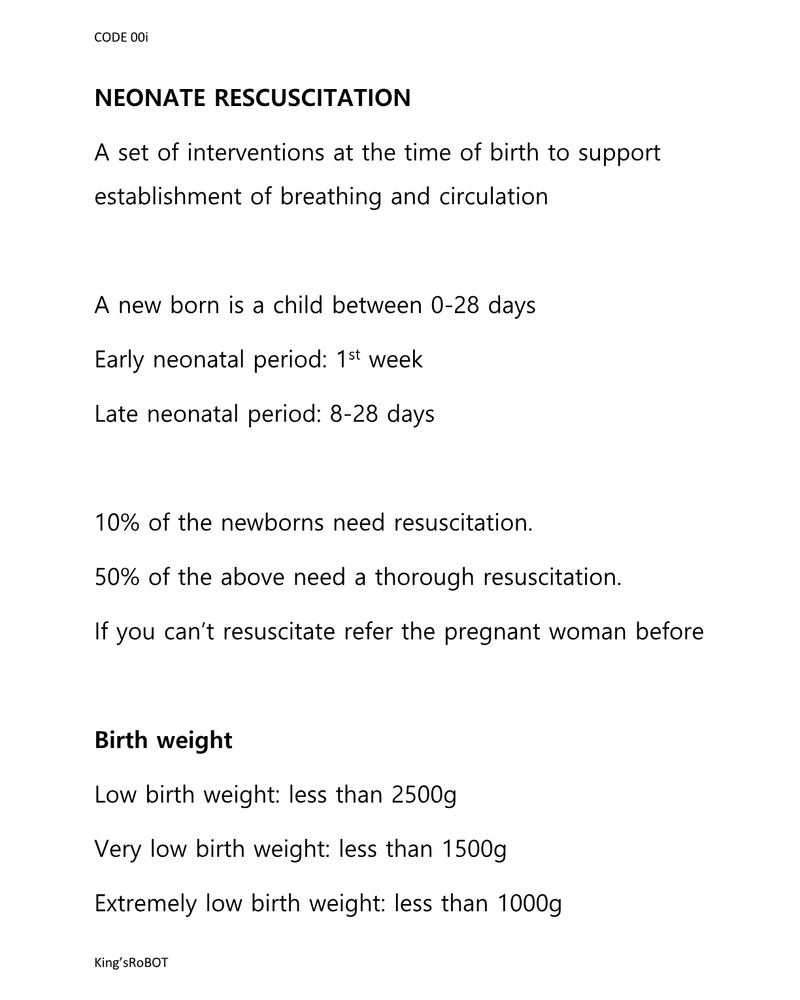
Hypothermia significantly compounds metabolic acidosis and hypoxia in the newborn. Preventing heat loss is an essential component of the resuscitation pathway.
Immediate Thermal Care: Ensure dry, sterile linen is readily available in the delivery room to immediately dry the baby upon birth.
Resuscitation Ambient Environment: Ensure the delivery room's designated resuscitation area is structurally warm.
Target Core Temperature: The primary clinical goal is to maintain the newborn's core body temperature strictly between 36.5 degrees Celsius and 37.5 degrees Celsius.
Warmer Optimization: The radiant warmer must be fully functional. It must be turned on prior to the delivery of the baby so that the mattress is pre-warmed.
Pre-Warmed Linens: Lay the designated baby receiver clothes directly on the radiant warmer platform while awaiting delivery. This thermal preparation must be performed in both standard labor rooms and major operating theaters.
Proximity of Kits: Ensure that all prepared resuscitation kits are within arm's reach of the functional radiant warmer.
Element 4: A — Prepare for Suction and Oxygen Source with Pulse Oximetry
Airway clearance and oxygenation matching must be prepared before the infant is delivered.
Suction Preparedness: Ensure all mechanical or manual suction equipment is verified as functional within the delivery room. A clean, reusable penguin sucker or specialized suction tubes must be ready for use.
Heart Rate Monitoring: A functional pulse oximeter must be available to monitor the baby's heart rate continuously during the resuscitation process.
Oxygen Synchronization: Ensure a potent, reliable oxygen source is present in the delivery room and connected directly to the neonatal resuscitation bag.
Anatomical Positioning: Correctly position the baby in the "sniffing position" (slight neck extension) to optimize airway patency.
Element 5: V — Effective Neonatal Resuscitation Using Bag and Mask Ventilation
When a newborn fails to breathe spontaneously, effective positive pressure ventilation is the most critical step in reversing birth asphyxia.
Timely Resuscitation: Initiate early, appropriate neonatal resuscitation inside the delivery room without delay.
Positive Pressure Ventilation: Administer effective bag and mask ventilation, ensuring a tight seal and visible chest rise.
Advanced Airway Control: Secure the airway via Endotracheal Tube (ETT) ventilation where possible, which is a standard expectation at tertiary institutions.
Algorithm Adherence: Follow the precise clinical steps outlined in the Helping Babies Breathe (HBB) and advanced neonatal resuscitation protocols.
Delivery Room CPAP: Immediately initiate delivery room Continuous Positive Airway Pressure (CPAP) if the newborn exhibits signs of respiratory distress, persistent hypoxia, or if the oxygen saturation (SpO2) remains less than 90% despite adequate initial efforts.
Element 6: E — Stable Referral or Admission of the Newborn
Resuscitation does not conclude when the baby begins to breathe; stabilized transition of care is necessary for survival.
Post-Stabilization Admission: Escalate care by admitting the newborn to a dedicated neonatal unit or Special Care Baby Unit (SCBU) immediately after acute stabilization is achieved in the delivery room.
Objective Escalation Threshold: Always escalate care and admit or refer any baby presenting with an APGAR score of less than 7 at the 5-minute mark.
Lower-Level Facility Protocol: If managing a delivery at a lower-level facility that lacks a functional newborn care unit, stabilize the infant according to protocol and arrange for a secure transfer.
Advanced Delivery Room Interventions: In the presence of a highly skilled team, advanced delivery room care may be expanded prior to transfer to include:
Endotracheal intubation.
Emergency umbilical vein catheterization (UVC).
Nasogastric (NG) tube insertion for gastric decompression.
Administration of Adrenaline.
Intravenous (IV) fluid administration for volume expansion.
Safe Transport Protocols: Transport the baby warm from the delivery room to the neonatal unit. Utilize a low-cost transport bed equipped with an integrated oxygen cylinder, a portable CPAP machine, and a Warmilu or similar exothermic warming mattress.
Element 7: D — Documentation of All Interventions
Accurate medical documentation provides the legal record of care and ensures clinical continuity during handovers between delivery teams and neonatal units.
APGAR Recording: Correctly record the exact APGAR score of the newborn at the 1-minute, 5-minute, and subsequent intervals during the resuscitation efforts.
Process Timeline: Meticulously document all processes, interventions, and medications administered, charting sequentially from the exact time the fetal or neonatal risk was identified.
Record Quality: Maintain proper, accurate, and highly legible records.
Continuity Tools: Utilize the standardized Neonatal Admission Tool to record the relevant maternal and intrapartum history required for the long-term care of the baby upon transfer or referral.
Cross-Department Responsibility: The maternity and labor ward teams know the detailed intrapartum history of the baby best; therefore, the delivery team is strictly responsible for filling out the neonatal admission form before handover is complete.
Key Pearls and Takeaways
Action at 120 BPM: A fetal heart rate below 120 beats per minute is an urgent warning sign of distress. Do not delay decision-making when this threshold is crossed on the partograph.
Turn on the Warmer Early: Never wait until a baby is born to turn on the radiant warmer. It must be turned on and warming the receiver blankets prior to delivery to prevent hypothermia-induced metabolic deterioration.
Avoid Herbal Oxytocics: Educate clinical teams and communities against the use of traditional herbal oxytocics in labor, as they cause severe uterine hyperstimulation and direct fetal birth asphyxia.
The 5-Minute APGAR Rule: Any neonate with an APGAR score less than 7 at the 5-minute mark requires immediate escalation of care and admission to a neonatal unit or Special Care Baby Unit.
Document Before Handover: The maternity team is the primary repository of the baby's intrapartum history. The neonatal admission form must be filled out completely by the delivery team prior to transferring the baby.
References
Ministry of Health, Uganda. (2026). Uganda's Birth Asphyxia Care Bundle: "7 steps to ensuring babies breathe at birth" (PREWAVED Implementation Guide). Ministry of Health Guidelines.
Type: National Clinical Guideline
Ministry of Health, Uganda. (2024). Uganda Clinical Guidelines (UCG): National Guidelines for Management of Common Conditions. MoH Uganda.
Type: National Reference Manual
American Academy of Pediatrics, & World Health Organization. (2020). Helping Babies Breathe (HBB) (2nd ed.). AAP/WHO.
Type: International Resuscitation Protocol
American Heart Association, & American Academy of Pediatrics. (2021). Textbook of Neonatal Resuscitation (NRP) (8th ed.). AAP/AHA.
Type: Advanced Resuscitation Standard